


Rider Note: Video of the first day is here on the newsletter and here on YouTube. This gives you a more detailed insight into my headspace for people who prefer the written word over video.
The alarm goes off precisely at 6:00 AM. It takes my sleep-starved brain a moment to locate where I left my phone on the nightstand in order to slide the alarm off. The first thing I look at after putting in my lock code is the weather app. I guess a part of me hoped the forecast had somehow changed during the four-odd hours of sleep I sneaked in. It’s a fool’s wish, of course—the map is bright green across every inch of territory I would be traveling. I sigh and then make my usual mistake: I roll over and shut my eyes... just for a moment. A moment that turns into two hours, naturally.
Now, I’m late. I wanted to be on the trail by 8:00 AM or before. Groaning, I gather my things, brush my teeth, and begin hauling all my gear down to the garage that houses Indy. I have a lot of gear—probably too much—but this is what I had planned for, for logical reasons. Still, I mentally wince each time my duffel bags sway me into unstable footsteps down the many stairs of the hostel (hotel, really) that I’m staying in.
Loaded up, I hit the Washington, DC streets and headed toward my first mistake. I should have started out on the Capital Trail: a paved, concrete trail that winds through DC proper. I would get camera shots of the capital and government buildings—a fitting start to a celebration of the country. Instead, because I’m so focused on admonishing myself for being behind schedule, I head right to the start of the C & O Trail.
It begins behind a nondescript building with little fanfare or signs. Instead of paved streets and governmental building sightseeing as I ride through our capital, I’m on a dirt path barely three feet wide, riding behind buildings and greeting several homeless people who have turned the underpasses into home for the night. In retrospect, it’s probably a more fitting start; as much as America has to celebrate over the last 250 years, there are problems that remain with few workable solutions: homelessness, social unrest, and politicians who refuse to understand their roles, responsibilities, or oaths of office.
When I tell people about the project with my usual energy and goofy patriotic grin, some remind me of these realities—as if I don’t know them. I do. Everyone does. If you’ve been married for 50 years, I’m sure you can remember all the times your spouse didn’t clean the kitchen, cut you off, left the toilet seat up, etc., ad nauseam. Still, you’ve been married 50 years—see what I am saying? Nothing about America is perfect. We are just closer to perfection than anyone else in the world, now or in the past.
I ride until I reach a dead end in front of a highway bridge not suitable for bikes. I’ve made my second mistake of the day: I’ve missed a turn or something, and I’m off course. I’ve been riding a grand total of 20 minutes. It’s not really a big deal, but I’m annoyed to no end and voice my displeasure with a few choice sailors’ words. Indy is mortified.
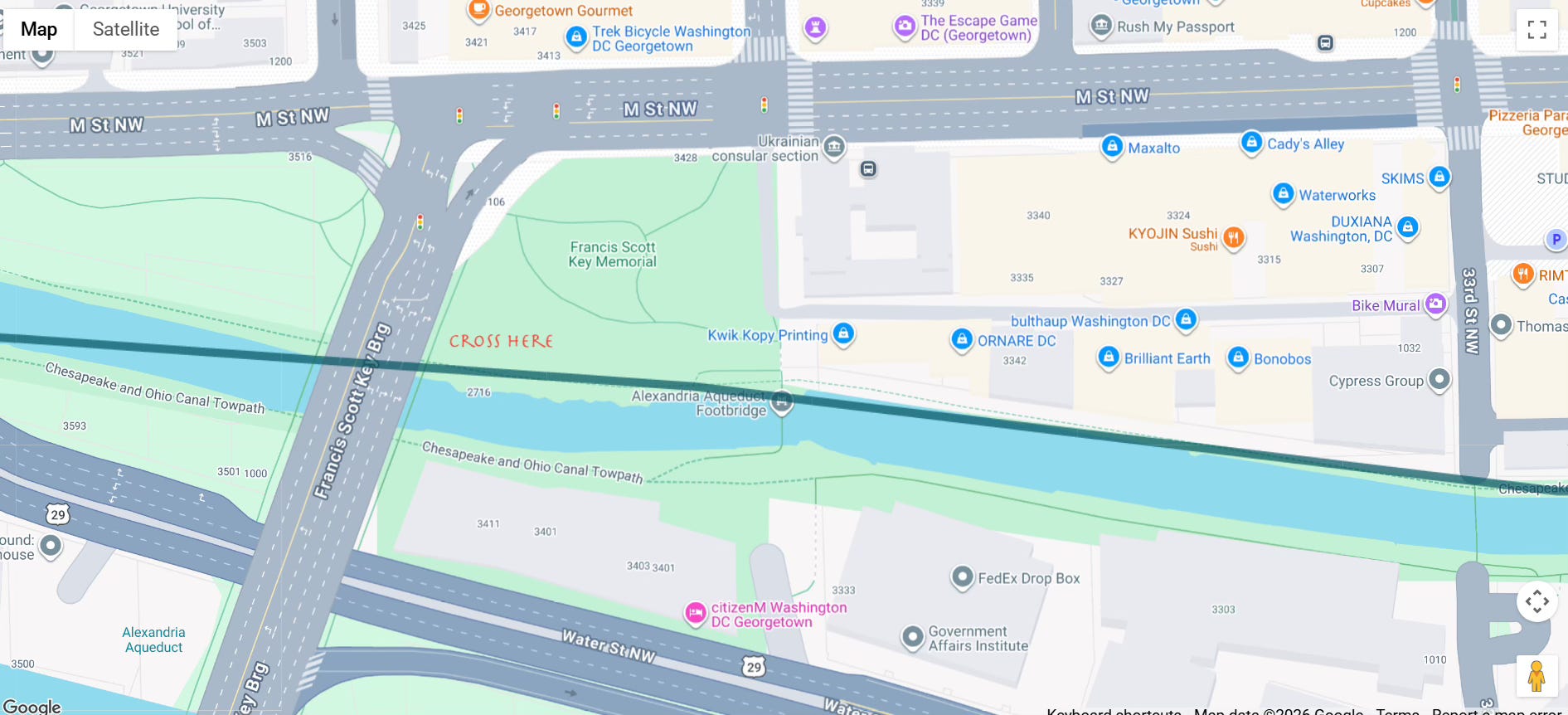
Sure enough, a half-mile back I missed the turn across an overlook bridge to stay on the trail. I’m not sure how I could have missed it, given the 6-inch sign hidden on the guardrails below waist height. Guess they get a ton of six-year-old cyclists that they need to direct to the pathway.
Once I’m on the trail properly with no turnoffs, I’m able to lean into the ride and make up ground—in my mind, at least, in some alternative reality. However, in the world I’m in, it’s rainy and cold. The trail is peat, gravel, and dirt, meaning it’s muddy and full of puddles every two to three feet. I’m weaving around so much to minimize splashing and mud that I’m surprised a cop hasn’t descended on the trail to check my blood alcohol level.
I’ve ridden the C & O Trail in the rain before and know how dirty you can get, but nothing prepared me for this ride. At some point, you just give up trying not to splash around; there is no point. Puddles large and small, shallow and deep, are everywhere, and you cannot avoid them. An hour into the ride, my cycling sneakers were soaked and filled with water.
When I stop for a drink of water and look at my bike, I realize I have underestimated the reviews about my trailer and its performance in the rain. It pulls behind me perfectly—I can barely feel it’s there except for the rattling it makes going through muddy ruts—but it’s a filthy mess. I look inside and see water pooling. Because the trailer’s bottom is not fully enclosed, my bags have become wet and are a quarter covered in grit. I make a note to myself to be sure to point this out to my audience, but I shrug it off. There’s nothing to do about it, and I’ve got quite a ways to go to reach my chosen endpoint for the day.
I want to make it to Brunswick, a large campground that has electricity, showers, and a large tent camping site or log cabins to rent for the night. It’s 60 miles to reach it. Ambitious, but doable—easily on a regular bike. But I don’t have a normal bike; I have an e-bike, so I have to be concerned with battery usage. This is the first time I am touring on Indy with a full loadout, and I do not know the mileage I can expect with my weight and the trailer. So, I’m more than paranoid about my power percentages and the level of assist I’m using.
I’m in Sport mode for most of the morning. It is only the second level up, but I’m not ride-acclimated yet and the cold is affecting my pedaling performance. Plus, I know the C & O Trail is mostly primitive. There are well-water pumps and porta-potties every few miles, but no electricity and no trash cans. By the time I reach the visitor center near Great Falls, I’m just below 50% power.
Paranoid as all get-out and tired of riding in the constant rain, I stop and ask if I can charge my battery. The staff is gracious and happy to see someone other than a trail volunteer. It’s Memorial Day weekend, and the Falls visitor center should be bustling, but the rain has left the trails empty. Only a few fools like myself are riding.
This is my first lesson in e-bike touring: in truth, you can find outlets somewhere just about everywhere, but the real problem is that it takes a long time to charge—and the cold is not helping. I sit around charging the bike for nearly two hours before I get too antsy to wait anymore. I get back on the trail with Indy charged to 75%, resolved to keep the bike in Eco mode. I am not nearly as close to my goals as I want, and daylight is burning away.
Back on the trail, I run into my next difficulty—one that I had expected and planned for: deadfalls. A storm cannot come in the vicinity of the C & O without blowing down trees on the trail. I knew this was a possibility and even packed a folding handsaw to deal with the ones I could not move around or over. I run into my first one and then several more, slowing my travel time significantly. I’m also doing my best to avoid branches and sticks; even a slight branch could hit your wheels just right and fly into your chain. Nothing would be worse than a chain issue on the C & O in the middle of a rainstorm.
For all the months prior, I envisioned how I would approach and document the trail: tons of photos, videos of the falls, forts, and locks, along with in-depth commentary on the lock houses and funny banter between myself and my bike avatar, Indy. But I’m too focused and miserable to do anything other than hit record on one of my cameras and hope the footage is usable. I need to get to where I’m going, and I want to get there now.
In short order, I’m a good 20 miles from my chosen destination and below 20% in battery power. I need another charge-up, and I’m convinced that something is wrong with my battery—it should not be losing power so quickly. It’s coming up on 5:00 PM and I only have 2 hours of daylight left (less even, given the heavy cloud cover). Plus, the weather app on my phone is projecting a move from constant rain into severe thunderstorms.
I’m near White’s Ferry, which I know has a diner where I can charge and maybe get something to eat. That becomes my immediate destination, and I become a habitual map-watcher, keeping an eagle eye on the little dot on my phone that represents me and how close or far I appear to be. Relief hits me as I reach the road turnoff from the trail. I need a snack and power, and then I need to haul ass to my destination. You do not want to be on the trail in a thunderstorm, trust me—I’ve been there, done that, and don’t want to see it again.
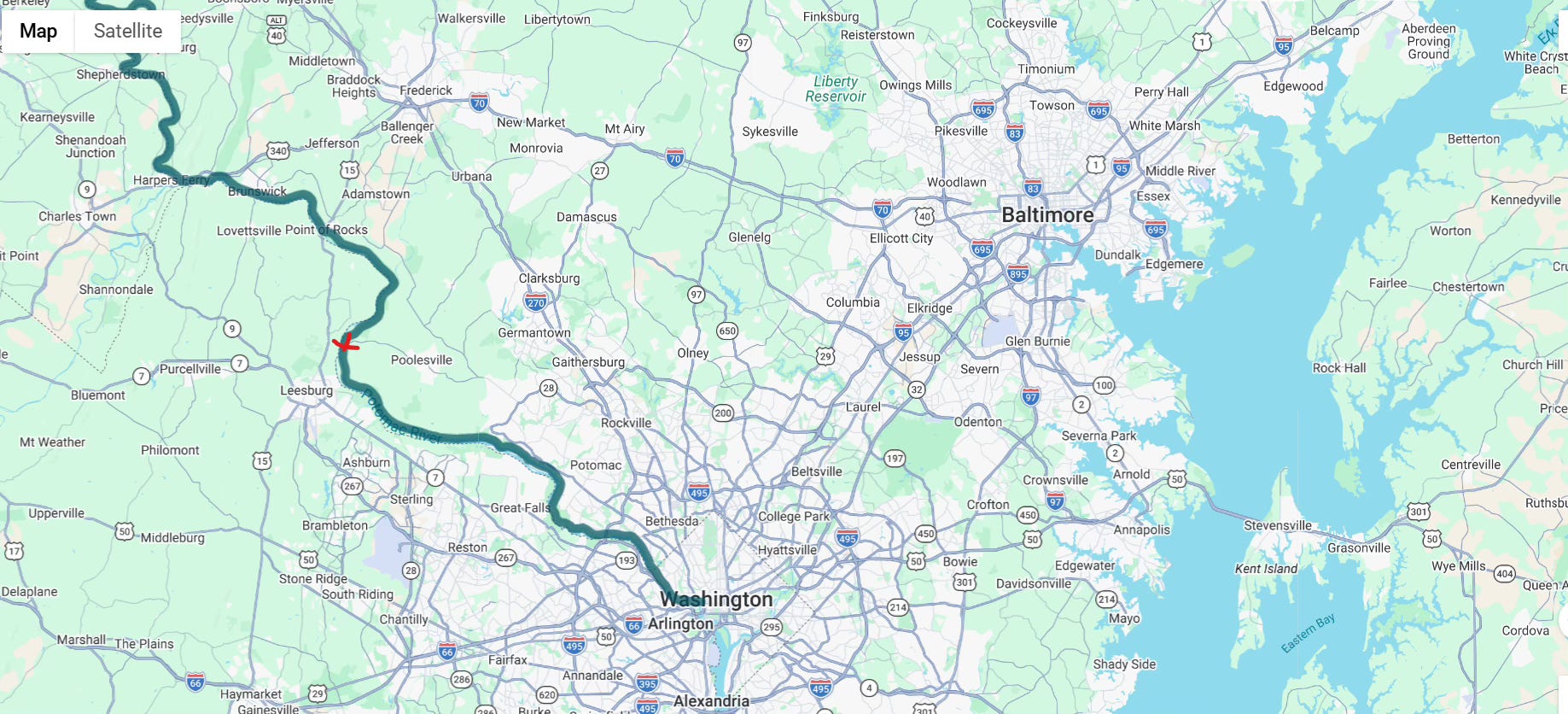
As I pedal toward the diner, I see something that perks my interest. The diner is next to a large open field that used to be used for parking when the ferry was operational (COVID destroyed that), and a covered pavilion with picnic tables stands next to it. I immediately think, “I should stay there.” I do not know if it’s allowed since it’s not an official campground, but I’m leaning toward throwing caution to the wind and camping out.
The staff at the diner is great. They are closing up, but they allow me to order and go into the back kitchen to wash my hands. White’s Ferry Grill is the only nearby trail food option between DC and the town of Brunswick—it is the only game in town, so if you are traveling the trail, stop by and show some love. With the ferry closed, their only steady business comes from hikers, cyclists, and the sparse number of people who live nearby.
As I am eating, the owner comes in bringing supplies for the next day’s business. I indirectly ask him if camping is allowed at the pavilion. He just looks at the weather outside and tells me he would. Then I get a second confirmation as a couple comes into the diner. They are traveling the country as well and have been camping out at the pavilion for the last three days trying to wait out the rain.
I got their names, though I’m embarrassed to say I cannot find where I wrote them down or recall them now. The older gentleman was in his 70s and bike-tours full-time. He sold his house, car, and most of his possessions, and rides a bike that is 20 years old, traveling continually across the country. He was headed toward Seattle along the Great American Rail Trail after leaving North Carolina to see his grandkids. It was a pleasant reminder that if you stay healthy, you do not have to cram bicycle travel strictly into the years before retirement.
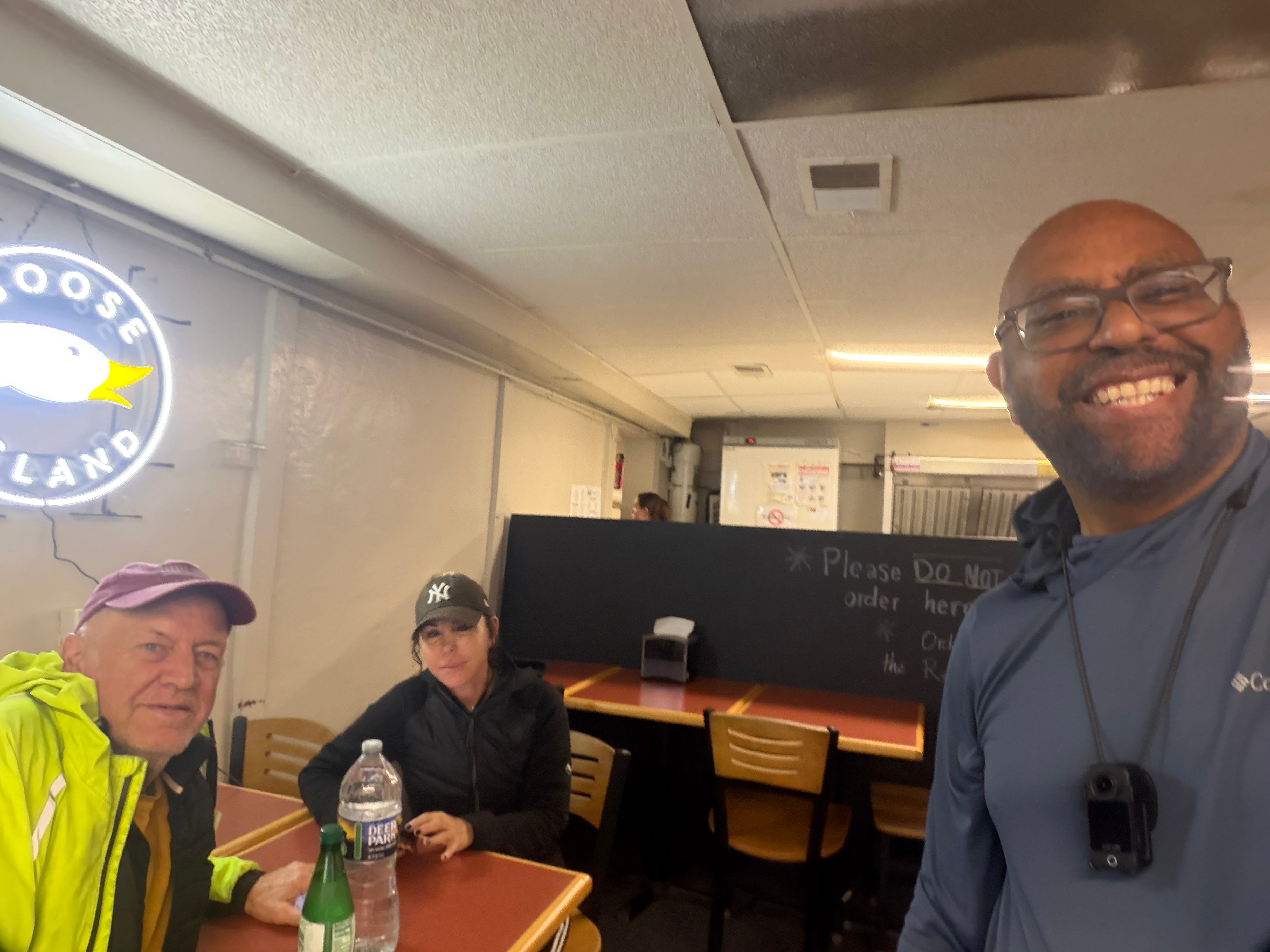
They took a photo with me and welcomed me over to the pavilion to set up my tent next to theirs for the night. Thus ended day one. I was wet and dirty, but I had shelter for the coming storm. Bicycle tourers call that a win.